SMR Trends 2026: Everyone Wants Reactors. Almost Nobody Is Building Them.
GO-IBR.com Research | Evidence as of 20 October 2026
Demand for small modular reactors (SMRs) is solved. Delivery is not.
Big tech wants firm, carbon-free power. Utilities want it. Governments are funding it. The announcements are endless.
But how much is actually being built? We tested eight SMR trends against the evidence. Here is what we found.
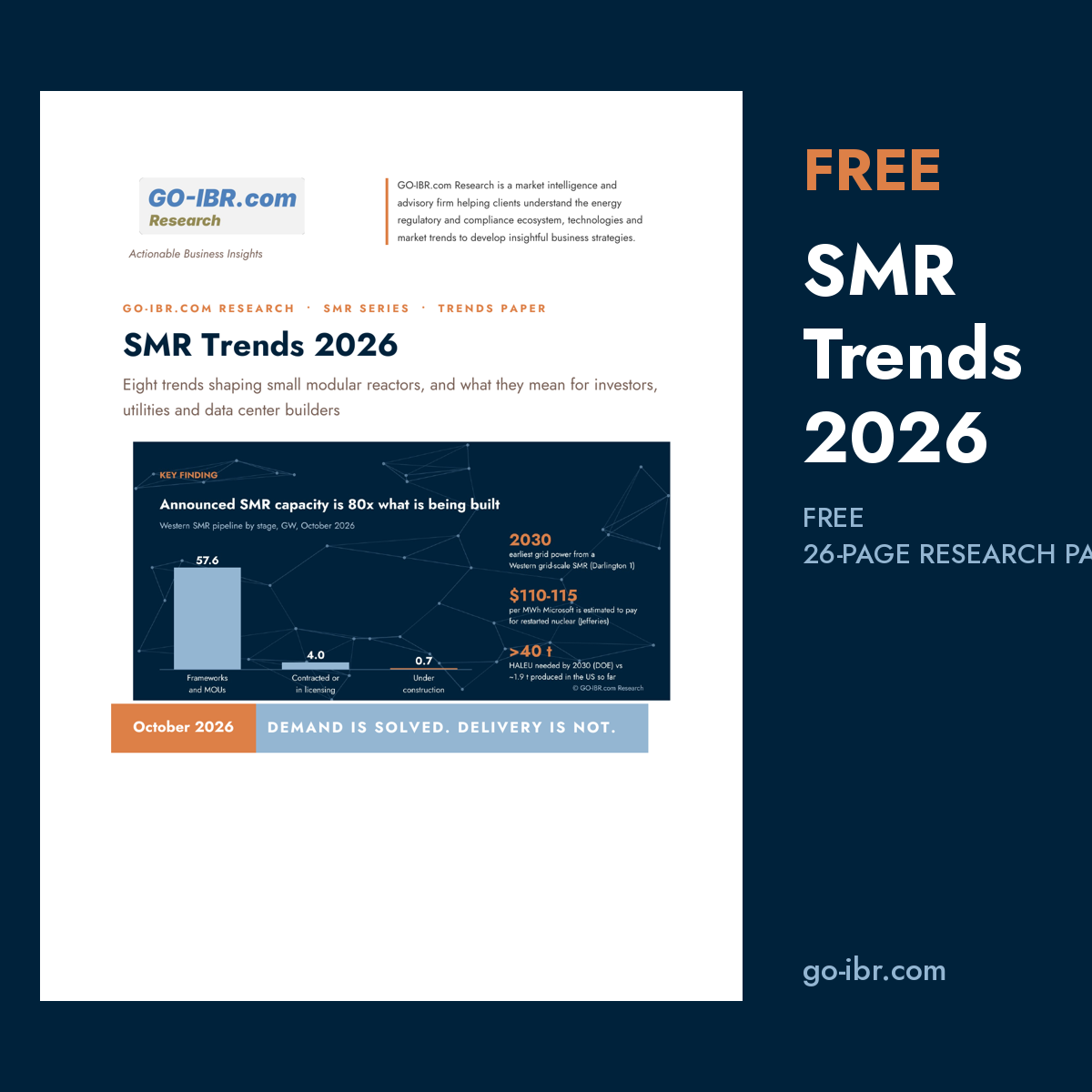
1. The 80x gap
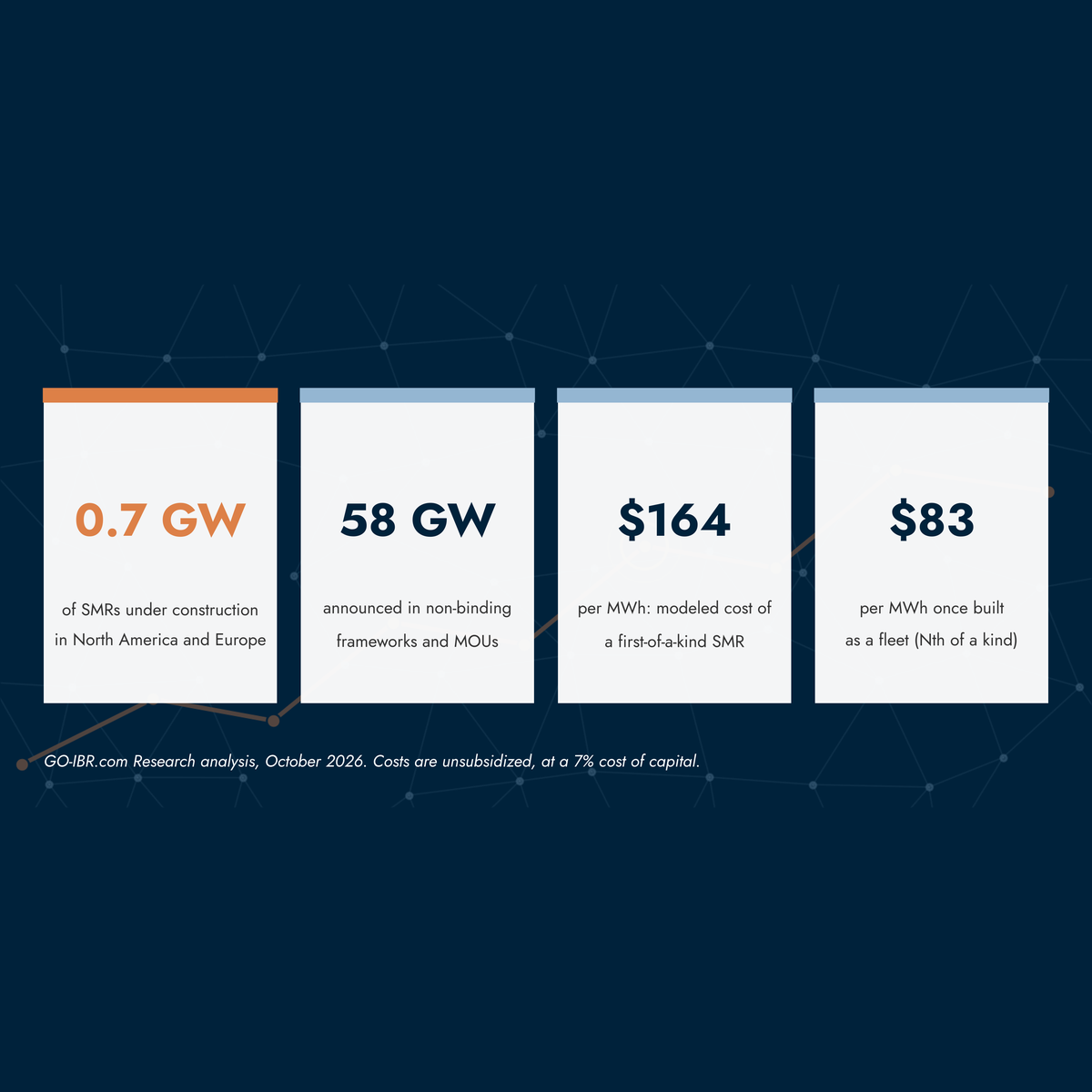
under construction
contracted, permitted or licensing
frameworks and MOUs
That is the Western SMR pipeline. The announced total is about 80 times what is under construction. A memorandum of understanding is not an order. We treat them differently.
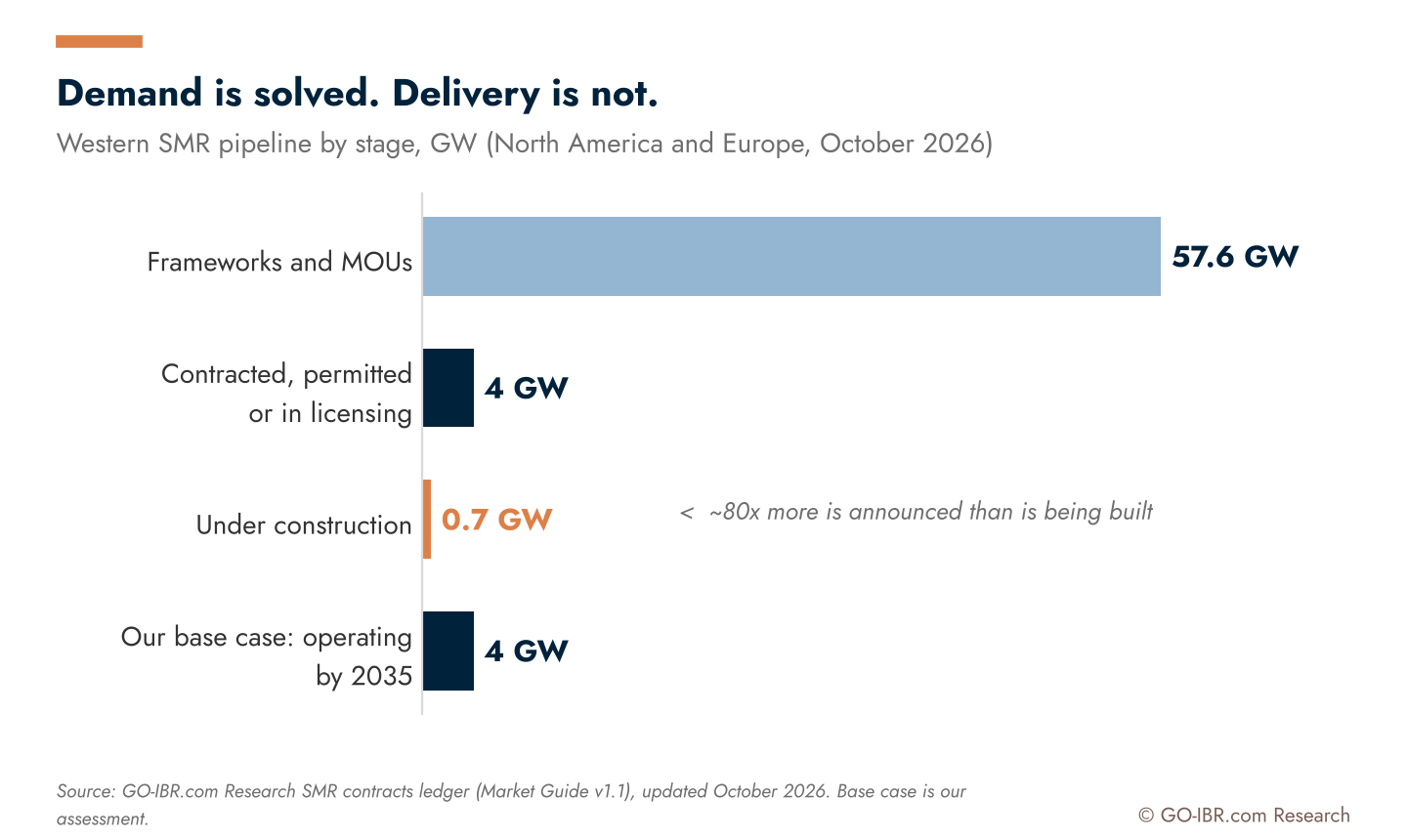
Announcements are options. Concrete is proof.
2. The real bottleneck: the order book
The first reactors cost far more than the later ones. The industry only gets cheap if enough units get ordered to ride the learning curve. We call the gap in between the “valley of death.”
Our model assumes a first unit at $12,000 per kW, and 300 MWe units. Then it all hinges on how fast the industry learns:
- 20% learning: 11 units, about $6 billion.
- 15% learning: 28 units, about $12 billion.
- 10% learning: 169 units, about $48 billion.
Somebody has to fund that gap. Governments? Buyer consortia? Hyperscalers paying up front? Our free Order-Book Bottleneck paper sizes it and ranks the options.
3. Coal plants are the shortcut
Old coal sites already have grid connections, cooling water and a skilled workforce. A 2022 DOE and Idaho National Laboratory study found 15 to 35 percent lower capital cost than greenfield. About 80 percent of the 394 coal sites it screened looked suitable. Our central case for light-water SMRs is 22 percent.
Fuel is the other watch item. Some advanced designs need HALEU, and supply is still being built.
4. SMRs are not cheap. But cheap is not the test.
| Power source | $ per MWh |
|---|---|
| SMR, first of a kind | 164 |
| SMR, early fleet | 120 |
| SMR, mature (nth of a kind) | 83 |
| New U.S. gas | 53 to 62 |
| Existing nuclear deals (Susquehanna, Comanche Peak, Crane) | about 65, 90, 101 |
GO-IBR.com Research model, 7% cost of capital, unsubsidized. Nuclear deal prices: Enverus, April 2026.
New gas wins on price. Nobody disputes that. But hyperscalers will pay roughly $139 to $157 per MWh delivered for clean, firm power that arrives fast. Early-fleet SMRs fit inside that range. First-of-a-kind units do not.
5. For data centers, speed beats price
Power is only about 8 percent of an AI campus’s annual cost. A year of delay costs far more than a few dollars per MWh. We value getting power 3 to 5 years sooner at an extra $27 to $45 per MWh.
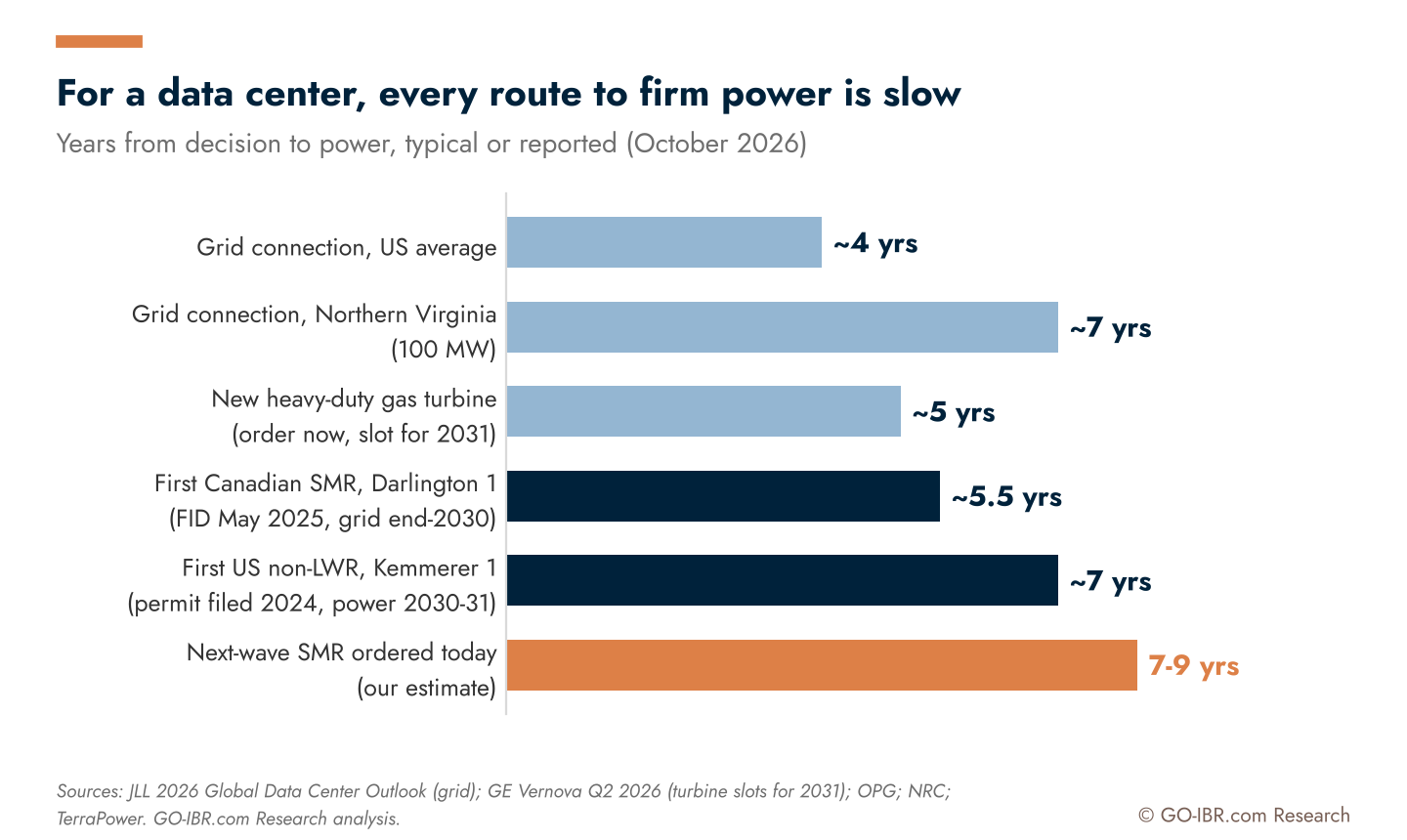
So ask every SMR developer for schedule evidence, not just a price. Our paper has seven questions to ask them.
6. What we are waiting for
- First concrete on commercial Western SMRs.
- Real cost and schedule numbers from the first units.
- Frameworks turning into financed orders.
- Dependable HALEU supply.
- First power, then a falling cost curve.
Some of it is moving. NuScale’s US460 design won standard design approval in May 2025. TVA received a construction permit for the BWRX-300 at Clinch River in September 2026. The BWRX-300 at Darlington in Ontario is under construction.
Our base case: about 4 GW of SMRs operating in North America and Europe by 2035. A real industry. A fraction of the hype.
What to do about it
- Investors: track binding orders, not announced gigawatts.
- Utilities: look hard at coal sites you already own.
- Data center builders: price in speed, demand schedule proof, and plan bridging power.
Start with the free reports
No paywall. Add to cart, check out at $0.00, download the PDF.
- SMR Trends 2026 (26 pages): the full evidence and nine dated calls. Direct PDF
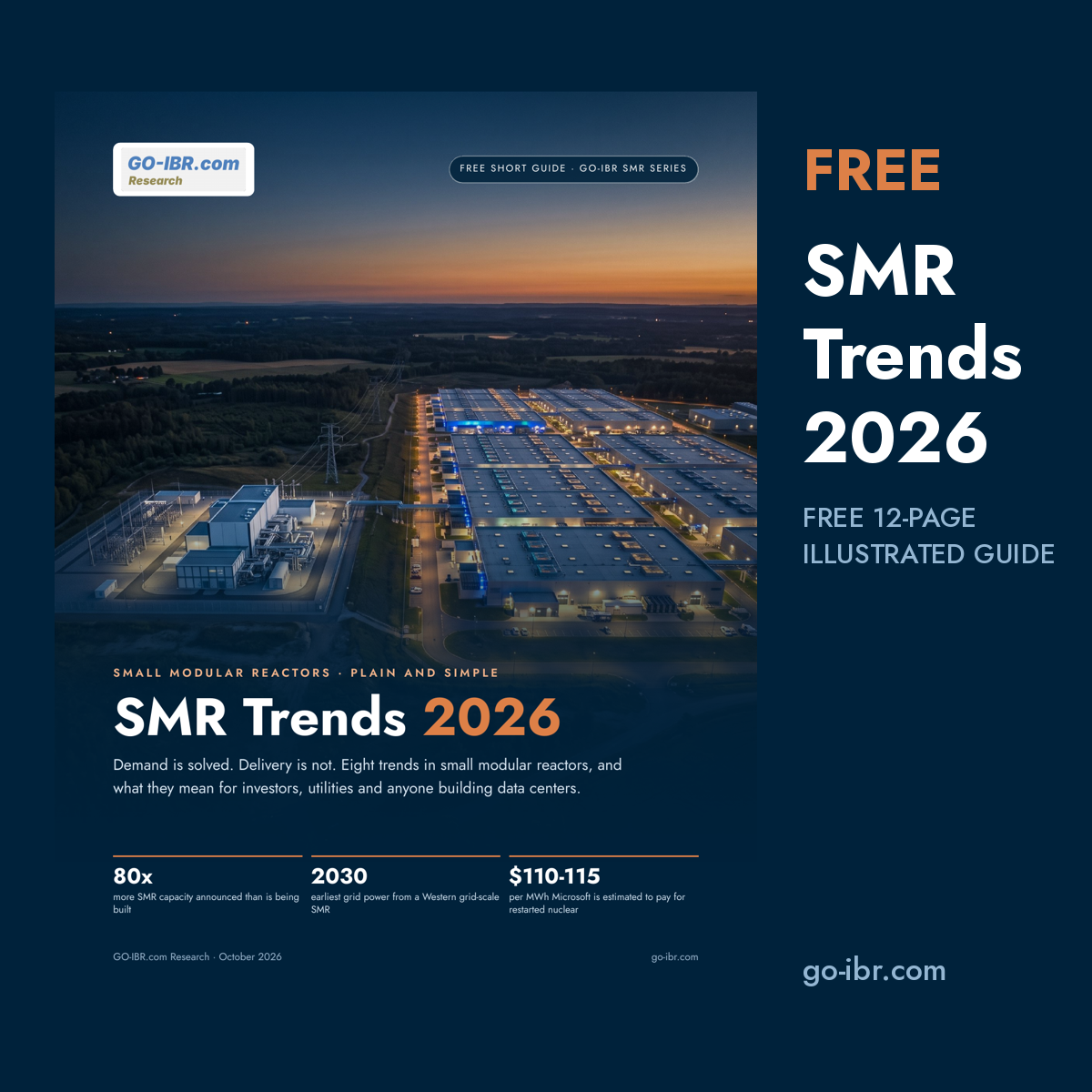
- SMR Trends 2026: The Short Guide (12 pages): the quick, illustrated version. Direct PDF
- SMR Primer: new to nuclear? Start here.
- Three Nuclear Accidents and the SMR (blog): what TMI, Chernobyl and Fukushima mean for SMR safety claims.
- Order-Book Bottleneck: how to fund the valley of death.
Get the next SMR paper first
Your download stays free and instant, with no sign-up needed. If you’d like our next SMR and energy research in your inbox when it comes out, leave your email.


We only use your email to send GO-IBR.com Research updates. We never sell or share it.
Need the full numbers?
- SMR Market Guide, 69 pages, $495. Players, contracts, economics, outlook to 2035.
- Data Center Co-location Report, 15 pages, $125. What it costs to power AI behind the meter.
- Coal-to-Nuclear Report, 14 pages, $125. Brownfield projects and savings.
For more analysis on small modular reactors, please contact us.
Disclaimer. Information only. Not investment advice, and not a rating or recommendation of any company or security. Cost and willingness-to-pay figures are GO-IBR.com Research model estimates (7 percent cost of capital, unsubsidized, 2026 dollars), not vendor pricing forecasts. Pipeline figures mix announcements of differing status. GO-IBR.com Research has no commercial relationships with the companies named. Permits and construction milestones change quickly; check current status before relying on them.
Sources. GO-IBR.com Research: SMR Trends 2026 (October 2026), SMR Order-Book Bottleneck, SMR Market Guide, SMR Data Center Co-location Report, SMR Coal-to-Nuclear Conversion Report. U.S. DOE and Idaho National Laboratory, coal-to-nuclear study (INL/RPT-22-67964, 2022). Enverus, observed nuclear power prices (April 2026). NRC, TVA and Ontario Power Generation public announcements, as compiled in the papers above.